


In oil production, chemical treatment is not just about pumping chemicals from surface. The real question is much sharper: can you deliver the right chemical to the right place, at the right time, without pulling the pump or disturbing the production string?
That is where a chemical injection mandrel becomes valuable.
For operators dealing with corrosion, scale, wax, paraffin, mineral buildup, gas interference, or unstable production conditions, traditional chemical treatment methods can be slow, expensive, and imprecise. Surface injection may not always reach the critical downhole location. Batch treatment may require operational interruption. In some wells, solving one problem creates another: pulling the pump, pulling the rod string, or exposing the well to unnecessary downtime.
TubePlus develops chemical injection mandrel solutions for operators who need a more practical way to manage downhole flow assurance. By installing the mandrel directly in the production tubing string, operators can inject chemicals exactly where they are needed, either continuously or in batch mode. The goal is simple: protect the well, extend equipment life, reduce intervention frequency, and keep production moving.
But to understand why this product matters, we should begin with a real industry lesson.
A Case Lesson from Chemical Injection Mandrel Failure
A public technical discussion on LinkedIn highlighted a failure case involving a chemical injection mandrel used in harsh HPHT service. The failure was linked to several technical risks: excessive hardness in the welded joint, susceptibility to stress corrosion cracking, H₂S and chloride exposure, possible material mismatch, and insufficient post-weld heat treatment.
This is a serious lesson for the oilfield.
A chemical injection mandrel is not a simple accessory. It is part of the pressure-containing and flow-management system. If the material is wrong, the weld area is weak, the hardness is uncontrolled, the corrosion resistance is insufficient, or the injection connection is poorly designed, the mandrel may become a failure point instead of a solution.
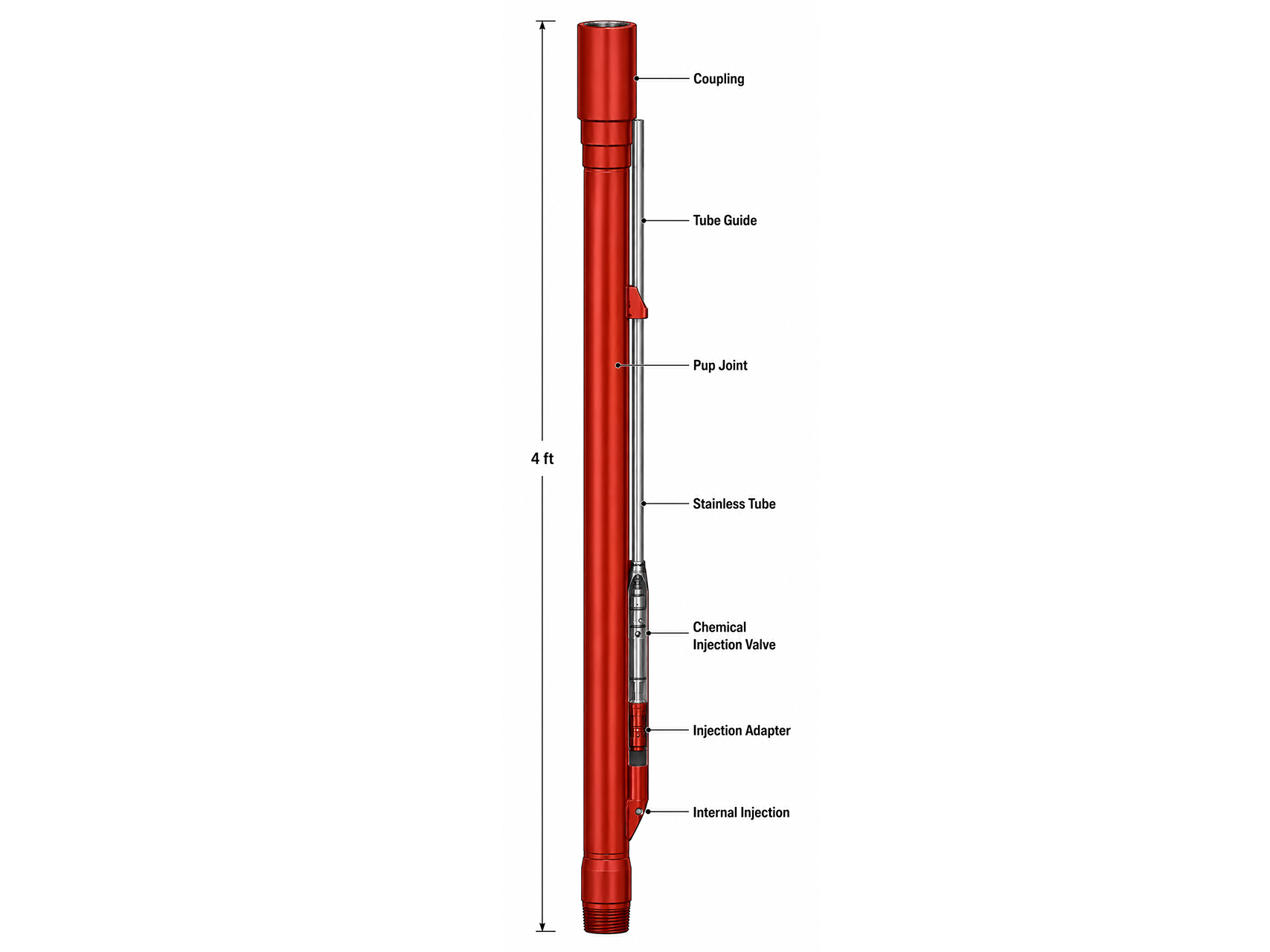
For operators working in corrosive wells, sour service, high-temperature wells, or wells with scale and paraffin issues, the mandrel must be engineered as a complete system. The body, injection adapter, stainless tube, tube fitting, injection valve, connection port, sealing path, and bypass area must all work together.
TubePlus uses this kind of industry lesson as a design direction: reduce unnecessary weak points, control the injection path, protect the tubing string, and make chemical delivery more reliable.
TubePlus Chemical Injection Mandrel: Designed Around the Actual Well Problem
TubePlus Chemical Injection Mandrel in oil and gas is designed for practical downhole chemical placement. The product concept is not complicated: install the mandrel in the tubing string like a coupling, connect the injection line, and deliver chemical into the tubing where treatment is required.
But the engineering behind it matters.
A good mandrel should be easy to install, strong enough for downhole service, resistant to corrosion, streamlined for running, and compatible with different chemical injection tube fitting configurations. It should also provide enough bypass area to avoid unnecessary restriction and reduce the risk of sand or gas-related accumulation around the mandrel.
The TubePlus solution focuses on five practical objectives.
First, it helps inject chemical at the target depth. Second, it supports continuous or batch treatment. Third, it reduces the need to pull the pump or rod string for chemical treatment. Fourth, it protects tubing and rods from corrosion, scale, wax, and paraffin-related damage. Fifth, it improves confidence through controlled structure and inspection documentation.
This is not just a product feature list. It is a field problem-solving logic.
tion path as one integrated system.
How the Mandrel Helps Operators Avoid Pump Pulling
One of the strongest values of a chemical injection mandrel is operational simplicity.
In many wells, traditional chemical treatment methods may require pulling the pump or rod string. That means downtime, labor cost, rig cost, production loss, and additional mechanical risk. In mature fields, especially rod-pumped wells with corrosion and paraffin problems, repeated intervention can quickly become a major cost driver.
A chemical injection mandrel helps avoid that problem by being installed with the tubing string. Once it is in place, the operator can inject chemicals through the connected line without further mechanical manipulation of the pump or rod string.
This matters because workover cost is not only the service invoice. It also includes lost production, delayed operations, equipment handling risk, and the possibility of introducing new failure points during intervention.
If a mandrel can help the operator treat the well without pulling major downhole equipment, the return on investment can be significant.
Continuous Treatment vs. Batch Treatment
Different wells require different chemical strategies.
Some wells need continuous corrosion inhibitor injection because the production fluid is constantly aggressive. Some wells need periodic paraffin or wax treatment. Some wells need scale inhibitor at specific intervals. Some wells need chemical injection only after changes in production behavior.
TubePlus Chemical Injection Mandrel supports both continuous and batch treatment concepts.
In continuous treatment, chemical is injected at a controlled rate over time. This is useful for corrosion management, scale prevention, or long-term flow assurance. In batch treatment, chemical is injected at selected intervals to address buildup or specific well conditions.
The advantage of the mandrel is placement. Whether the operator chooses continuous or batch treatment, the chemical can be delivered near the problem zone instead of relying only on surface entry.
Better placement usually means better treatment efficiency.
Application Scenario: Permian Basin Rod-Pumped Wells
Consider a rod-pumped well in the Permian Basin facing repeated corrosion and scale buildup. The operator sees increasing pump load, unstable production, and recurring tubing or rod wear. Surface treatment helps temporarily, but the problem keeps returning because the chemical is not reaching the critical downhole interval effectively.
Instead of pulling the pump repeatedly for treatment or relying only on surface injection, the operator installs a TubePlus Chemical Injection Mandrel in the production tubing string at the desired depth. A stainless tube or capillary line is connected through a reliable tube fitting and injection adapter. The injection valve routes the chemical into the production string while helping prevent reverse flow.
After installation, the operator can inject corrosion inhibitor and scale inhibitor directly into the target zone. The chemical contacts the problem area earlier, treatment becomes more efficient, and the need for repeated intervention is reduced.
This is the type of application where the mandrel creates value: not by being complicated, but by making chemical placement more intelligent.
Material and Manufacturing Control: Avoiding Hidden Failure Points
The LinkedIn failure case reminds us that a mandrel can fail if metallurgy and manufacturing are not controlled. Excessive hardness, weld-related defects, poor heat treatment, material mismatch, and corrosion-sensitive microstructure can turn a chemical injection device into a downhole liability.
TubePlus focuses on a more controlled approach.
Depending on customer requirements, the mandrel can be designed with suitable alloy steel, stainless steel, nickel-plated alloy steel, or corrosion-resistant alloy options. For critical applications, the design can reduce unnecessary welds or optimize the body and injection path to reduce potential leak points.
Material certificates, dimensional inspection, thread inspection, pressure testing, valve testing, visual inspection, and fitting verification can be prepared as part of the quality documentation package.
In oilfield manufacturing, quality is not a slogan. It is evidence.
Testing and Documentation for Customer Confidence
A chemical injection mandrel should be shipped with the documentation needed for customer review and field acceptance.
Typical inspection and testing items may include:
material certificate, dimensional inspection report, thread gauge inspection, fitting connection check, pressure test report, injection valve test record, visual inspection report, coating or plating inspection, and final pre-shipment inspection.
For high-pressure or corrosive applications, additional testing may be required based on customer specifications. This may include hydrostatic pressure testing, sealing verification, hardness control, PMI, NACE-related material review, or third-party inspection.
The purpose of testing is not paperwork. The purpose is to reduce uncertainty before the product goes into the well.
Once a mandrel is installed downhole, inspection becomes difficult. Therefore, the product must be verified before shipment.
A chemical injection mandrel is not just a piece of metal installed in the tubing string. It is a flow assurance tool. It helps operators place corrosion inhibitor, scale inhibitor, wax treatment, paraffin control chemical, and other production chemicals exactly where they can do the most work.
The real value is not only chemical injection. The real value is fewer interventions, better equipment protection, lower risk of tubing and rod damage, more efficient treatment, and improved production reliability.
TubePlus Chemical Injection Mandrel is designed around this practical field logic. By combining mandrel body design, chemical injection tube fitting compatibility, injection valve integration, corrosion-resistant material options, controlled bypass geometry, and full testing documentation, TubePlus helps operators build a safer and more reliable downhole chemical injection system.
In the oilfield, the best chemical treatment is not the one that uses the most chemical. It is the one that reaches the right place before the problem becomes expensive.
That is the purpose of TubePlus Chemical Injection Mandrel.
FAQ
- What is a chemical injection mandrel used for?
A chemical injection mandrel is used to inject production chemicals directly into the tubing string at a selected downhole location. It is commonly used for corrosion control, scale prevention, wax treatment, paraffin control, and flow assurance.
- Can the mandrel support continuous and batch chemical treatment?
Yes. A chemical injection mandrel can support both continuous injection and batch treatment, depending on the operator’s chemical program and well condition.
- Why is tube fitting quality important for chemical injection mandrels?
The tube fitting connects the injection line to the mandrel. If the fitting leaks, loosens, or fails, the chemical injection system may lose pressure integrity or injection efficiency. Reliable tube fitting design is essential for system safety.
- What materials can be used for a chemical injection mandrel?
Material selection depends on well conditions. Common options may include alloy steel, nickel-plated alloy steel, stainless steel, and corrosion-resistant alloys for more severe environments.
- What information is needed for a customized chemical injection mandrel?
Customers should provide tubing size, thread type, pressure, temperature, injection line size, chemical type, well environment, H₂S or CO₂ condition, required material, valve requirement, and testing standard.